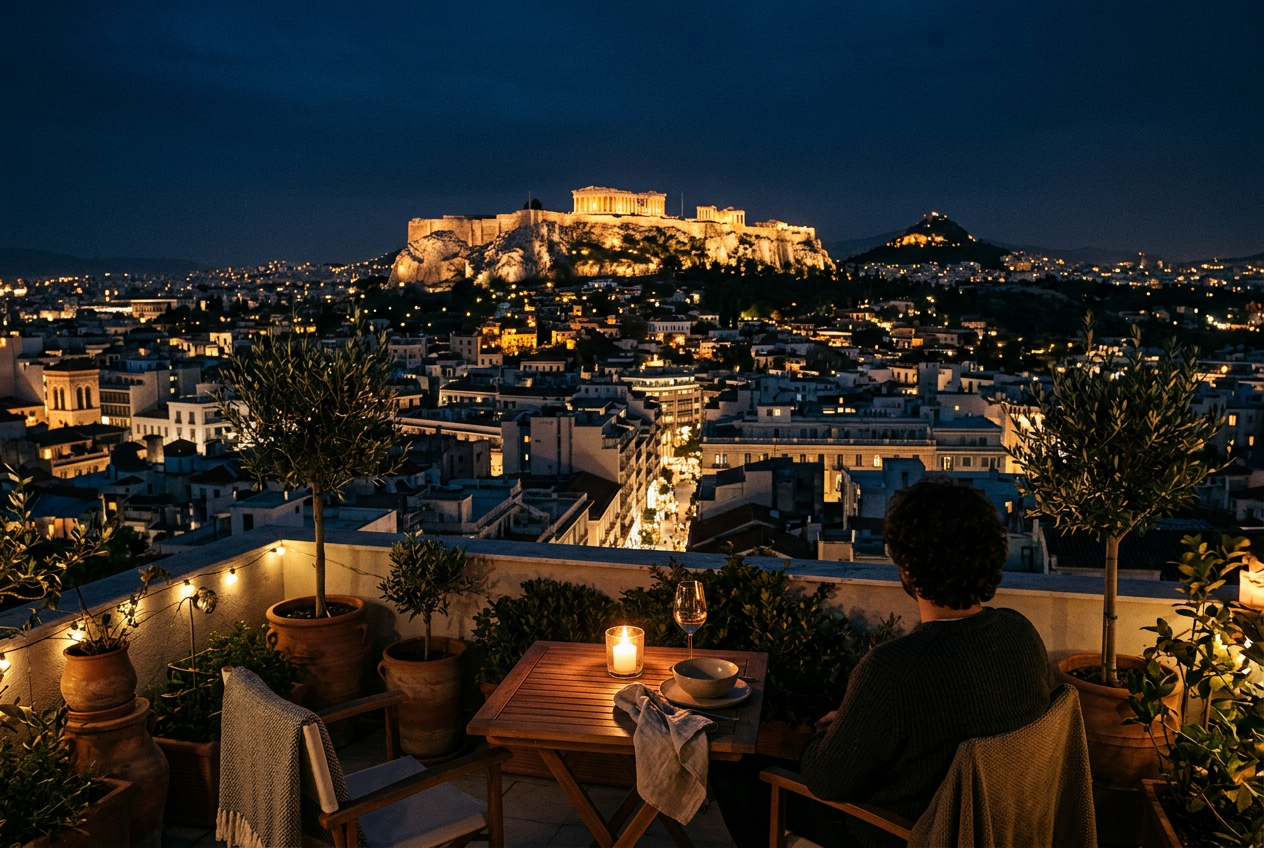
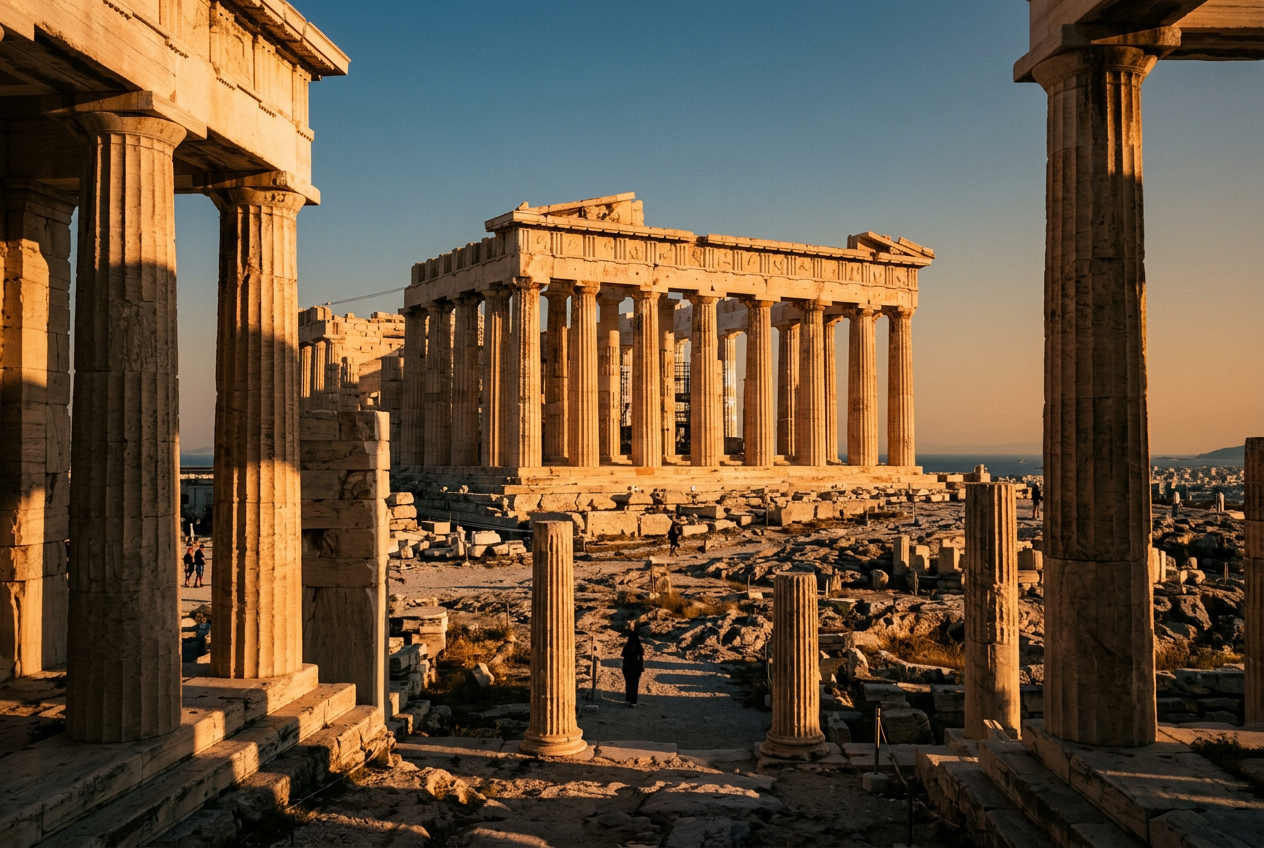
Athens carries 2,500 years without apology. Here’s how to do its ancient layer justice.
Most cities keep their history behind glass. Athens leaves it in the street. A Roman column holds up a Byzantine wall; a classical temple looks down on a Sunday market; the marble you’re standing on was laid for a festival that ended two thousand years ago. The ancient city isn’t a museum you visit. It’s the ground the modern one is built on.
Seeing it well is less about ticking off monuments than about understanding what you’re looking at — and choosing the hour, the order and the pace that let it land.
The Acropolis, Properly
Everyone goes to the Acropolis. Fewer go well. The single most useful decision you can make is when: arrive at opening, around 8am, or in the last two hours before closing. The midday crowds and midday heat are both worth avoiding, and the light at either end of the day does more for the marble than anything in between.
Approach on foot, through Plaka and up the western slope, rather than arriving by taxi at the gate. The climb matters — it’s how the building was always meant to be reached. At the top, the Parthenon gets the attention, but don’t rush past the Erechtheion and its porch of caryatids, or the long view back over the city from the eastern wall. Give it two hours. It rewards the time.

Where the City Did Its Thinking
Below the hill, the Ancient Agora was the engine room of classical Athens — its marketplace, its court, its parliament, the open ground where democracy was practised and Socrates argued his way toward a death sentence. It’s quieter than the Acropolis and more intimate, and the Temple of Hephaestus standing at its edge is among the best-preserved Greek temples anywhere.

A short walk east, the Roman Agora and the octagonal Tower of the Winds mark the city’s commercial heart under Roman rule — the Tower an ancient timekeeping device combining sundials, a water clock and a weather vane. Between the two Agoras, you cross five centuries of civic life without ever leaving the neighbourhood.
The Long Roman Shadow
Athens didn’t stop being built when the classical age ended. Hadrian’s Arch, raised in AD 132, marks the threshold between the old Greek city and the new Roman one Hadrian added beside it — two inscriptions on the same gate, naming two different cities. Just beyond it stand the fifteen surviving columns of the Temple of Olympian Zeus: the largest temple in Greece, seven centuries in the making, and best seen as the light goes gold.

The Panathenaic Stadium — rebuilt entirely in white marble for the first modern Olympic Games in 1896, on the footprint of an ancient one — closes the loop: antiquity revived, quite literally, in the same place it began.
How to Read the Layers
The trick to ancient Athens is to stop treating the sites as separate destinations and start reading them as one continuous text. A single morning’s walk can take you from a 5th-century BC temple to a Roman gate to a Byzantine chapel to a 19th-century stadium, all within a few hundred metres. The city never cleared the page; it just kept writing.
Buy the combined archaeological ticket — it covers the Acropolis, both Agoras, the Temple of Olympian Zeus and more, and saves both money and queueing. Then end at the Acropolis Museum, where the fragments finally make sense of the hill above. Its top floor, aligned exactly with the Parthenon and glazed on every side, lets you read the building’s sculptures against the building itself.
Antiquity in Athens isn’t roped off and reverent. It’s underfoot, built into, leaned against and lived around. The longer you stay, the less it feels like sightseeing and the more it feels like simply moving through a city that has never quite let go of its past — and never needed to.