The city operates on its own clock. Learn it, and the night opens up.
Arriving in Athens and trying to impose your home city’s evening schedule on it is one of the more reliable ways to have a mediocre time. The city operates on its own clock. Dinner at 7pm is a tourist schedule. Drinks at 9pm is warming up. The night doesn’t find its shape until well after midnight, and in summer it doesn’t end until the light starts coming back.
None of this requires stamina so much as willingness. Adjust the rhythm for a few days and Athens at night becomes one of the better arguments for the Mediterranean way of doing things.
The Shape of an Athenian Evening
The evening moves in phases. From around 7pm, cafés and bars fill with people having a first drink — not necessarily alcoholic, often coffee, because the Greeks are committed to drinking coffee at hours that would alarm most sleep specialists. This is the equivalent of an aperitivo hour, and it’s worth participating in rather than skipping straight to dinner.
Dinner happens between 9pm and 11pm in most neighbourhood restaurants. After midnight the plates are cleared and people either move on to bars or stay exactly where they are, because no one is coming to move them along. Last orders exist in Athens primarily as a theoretical construct. Bars run until 4am or later. Clubs don’t reach full energy until 2am.
The practical implication is that if you’re planning to go out properly, a late-afternoon nap is not indulgence — it’s logistics.
Where to Drink
Rooftop Bars
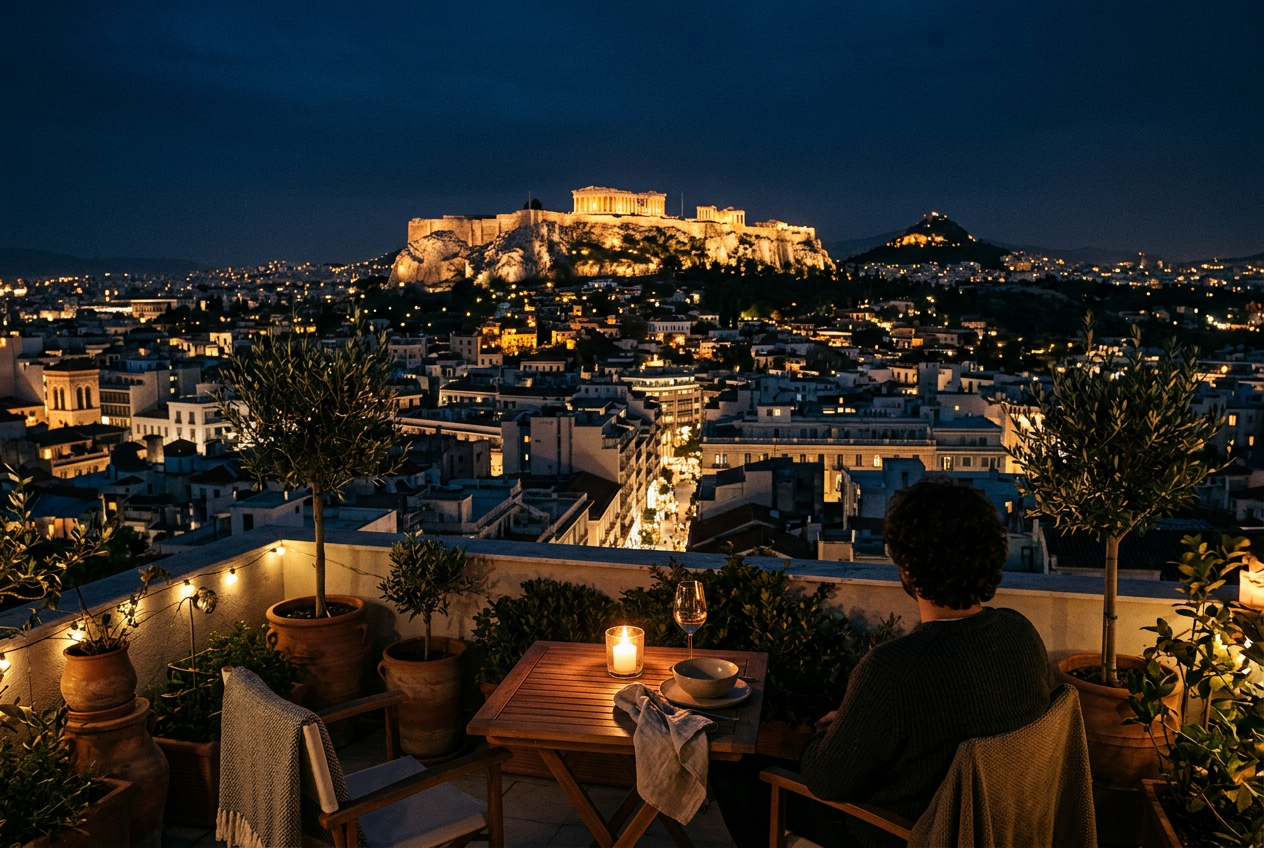
Rooftop bars with Acropolis views exist in quantity, and the quality varies enormously. The A for Athens rooftop on Miaouli Street in Monastiraki is the most photographed and remains worth visiting for the view, though go for a drink rather than a meal. The rooftop at the Electra Metropolis on Mitropoleos Street has a slightly more polished crowd and similar sightlines. Both are better at dusk than after dark, when the light on the Acropolis is more interesting than the floodlit version.

Monastiraki & Psyrri
The neighbourhoods for street-level energy: bars that open onto the pavement, music that gets louder as the night progresses, a mix of ages and nationalities that somehow remains Greek in feel. Bar Tristrato in Psyrri and Noel in Monastiraki are reliable anchors without feeling like tourist operations.
Kolonaki
Kolonaki runs at a different frequency entirely. This is the city’s affluent residential and commercial district: the bars are more expensive, the clientele more dressed up, the energy more controlled. It suits a particular kind of evening and makes a useful contrast to the looser atmosphere in Psyrri.
Thiseio
Thiseio sits at the base of the Acropolis on the western side, with a cluster of bars along Apostolou Pavlou Street that have some of the best unobstructed Acropolis views in the city. It’s quieter than Monastiraki — either a drawback or a recommendation, depending on the evening.

Live Music & Rebetika
Rebetika is the music you need to understand if you want to understand Athens. It emerged in the early 20th century from the urban poor — from the port cities, from the refugees of the 1922 population exchange with Turkey, from a culture of displacement and resilience. It sounds like nothing else: bouzouki-driven, minor-key, lyrically direct about suffering, hashish, prison and love in roughly equal measure. It became the soundtrack of working-class Greek life and influenced everything that came after it.

Live rebetika is still performed in Athens, primarily in small clubs called rebetadika. An evening there — late, smoky in atmosphere if not literally, with musicians playing for each other as much as for the audience — is one of the more affecting nights out the city offers. Stoa Athanaton, in the central meat market, has been running since 1930 and remains the reference point. The music starts late and the cover charge includes food.
Clubs & Late Nights
Gazi is the city’s main nightlife district, named for the former gasworks whose restored towers now anchor the neighbourhood. It’s dense with clubs and bars, runs late, and is at its most alive from around 1am. It’s not subtle, and it’s not pretending to be. If you want to dance in Athens through the winter months, this is where it happens.
Summer complicates things. A significant portion of the club scene migrates to the coast between June and September — to the string of beach clubs along the Apollo Coast south of the city. If you’re visiting in summer and serious about nightlife, the coastal clubs at Vouliagmeni and Varkiza are where the energy moves. Getting there requires a car or a taxi. Dress codes exist but are applied with less rigidity than in London or Milan; neat casual is usually sufficient, and trainers are fine in most places.
Athens at 2am, on a warm night, with the Acropolis lit above the rooftops and the streets still full — it’s one of those cities that doesn’t just tolerate being awake late. It’s built for it. The night isn’t something that happens after the day; here, it’s a different version of the same city, running at a different speed, and it’s worth staying up for.