The city has layers. Most visitors only ever see one.
The version of Athens at the top of most travel lists is real, and it’s worth your time. But it’s also the version that has been organised for external consumption — sign-posted, ticketed, reviewed forty thousand times. Running alongside it is a second city, quieter and less visited, that rewards the kind of travel where you’re willing to walk in a direction without being entirely sure what’s at the end of it.
This is an introduction to that version.
The Streets People Miss
Anafiotika
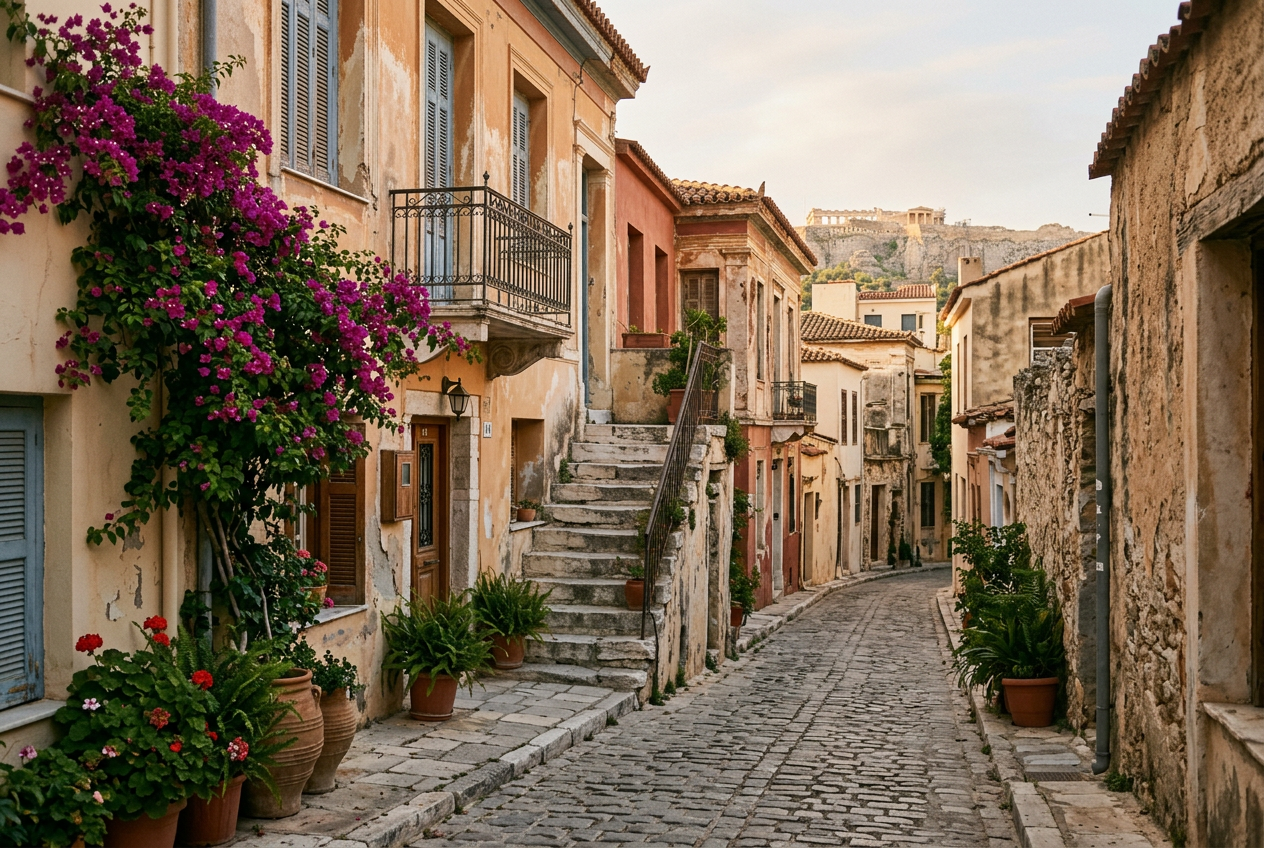
Anafiotika is one of the more unlikely things in Athens: a small Cycladic village transplanted almost wholesale onto the northern slope of the Acropolis in the mid-19th century, by builders from the island of Anafi who came to construct the new royal palace and built themselves a neighbourhood in the style of home.
The streets are narrow, whitewashed, plant-filled and almost entirely car-free. It is very quiet by Athens standards and feels, briefly, like being somewhere else entirely. Most visitors to Plaka never find it, because there are hardly any signs. Look for the small alleyways climbing the hill above Thespidos Street.

Ottoman & Byzantine Remnants
These are scattered through Monastiraki without much ceremony. The Tzisdarakis Mosque, built in 1759, stands in Monastiraki Square and now houses part of the Museum of Greek Folk Art. A few streets away, the Fethiye Mosque — the oldest in Athens, dating to the 1450s — sits inside the Ancient Agora, largely overlooked by visitors moving between the Stoa and the Temple of Hephaestus. These are not dramatic attractions. They’re the kind of thing you notice if you’re paying attention.
The Stoa of Attalos Lane
The quieter approach to the Agora, from the eastern side along Adrianou Street, runs past the exterior wall of the site and through a stretch of the city that feels unusually unhurried. The residential streets parallel to the Agora on its eastern side are among the least-walked in the central city.
The Museums Nobody Queues For
Benaki Museum of Greek Culture
On Koumbari Street in Kolonaki, this is one of the most comprehensive and beautifully curated collections in Athens, and on most days you can walk through it without navigating a crowd. The collection runs from prehistoric finds to Byzantine jewellery to regional costume to paintings of the Greek War of Independence. The building itself is a neoclassical mansion. The café on the ground floor is good. The rooftop terrace is better.

Museum of Greek Folk Art
Recently moved to a thoughtfully renovated neoclassical house in Monastiraki, it holds a collection of regional textiles, ceramics, embroidery and carnival objects that most tourists never think to look for. It’s small, specific and very good. Allow ninety minutes.
The Jewish Museum of Greece
On Nikis Street in Plaka, this documents a community and a history most visitors don’t know to look for. The Jewish community in Greece dates back over 2,000 years. The museum covers everything from the ancient Romaniote communities to the Sephardic Jews who arrived after 1492 to the devastation of the Holocaust, during which Greece lost approximately 87% of its Jewish population. It’s sobering, carefully presented and important.
Neighbourhood Walks with No Agenda
Mets
Mets sits between the old Panathenaic Stadium and the First Cemetery of Athens — itself worth a visit, as the mausoleum architecture and carved marble are extraordinary. The neighbourhood has the particular quiet of an area that has never been gentrified because it never needed to be: streets of low apartment buildings, neighbourhood kafeneions, very few tourists.
Pangrati
Immediately east of Mets and running at a slightly livelier frequency, Pangrati has good coffee shops, a few excellent bookshops, and — on Sunday mornings around Varnava Square — a relaxed, unhurried energy that represents a different Athens from the one down at Monastiraki.
Kypseli
Further north, Kypseli is in the middle of a slow, quiet transformation. One of Athens’ most affluent neighbourhoods in the early 20th century, it declined through the latter decades and is now, gradually, becoming interesting again: new restaurant openings, a renovated theatre, artists renting studios in the older apartment buildings. It’s early enough in that process that it hasn’t been discovered and packaged yet, which is most of the appeal.
The Views You Don’t Have to Queue For
Lycabettus Hill
The highest point in Athens at 277 metres, with a small church of St George at the summit and a 360-degree view that takes in the entire Attic basin, the coast, and on clear days the mountains of the Peloponnese. Reach it by funicular from Kolonaki or on foot via a path from Exarcheia. The view at dusk, when the city begins to light up and the Acropolis catches the last of the day, is one of the better things Athens offers.

Filopappou Hill
As covered in Athens on Foot, Filopappou gives a better angle on the Parthenon than most formal viewpoints — and, on a weekday morning, very few people.
The best version of Athens isn’t hidden, exactly. It’s just slightly off the path that’s been laid out for you. The city doesn’t curate access to itself; it simply exists, in layers, and rewards the people willing to walk one more street in either direction. The map is useful. Knowing when to put it away is more useful.