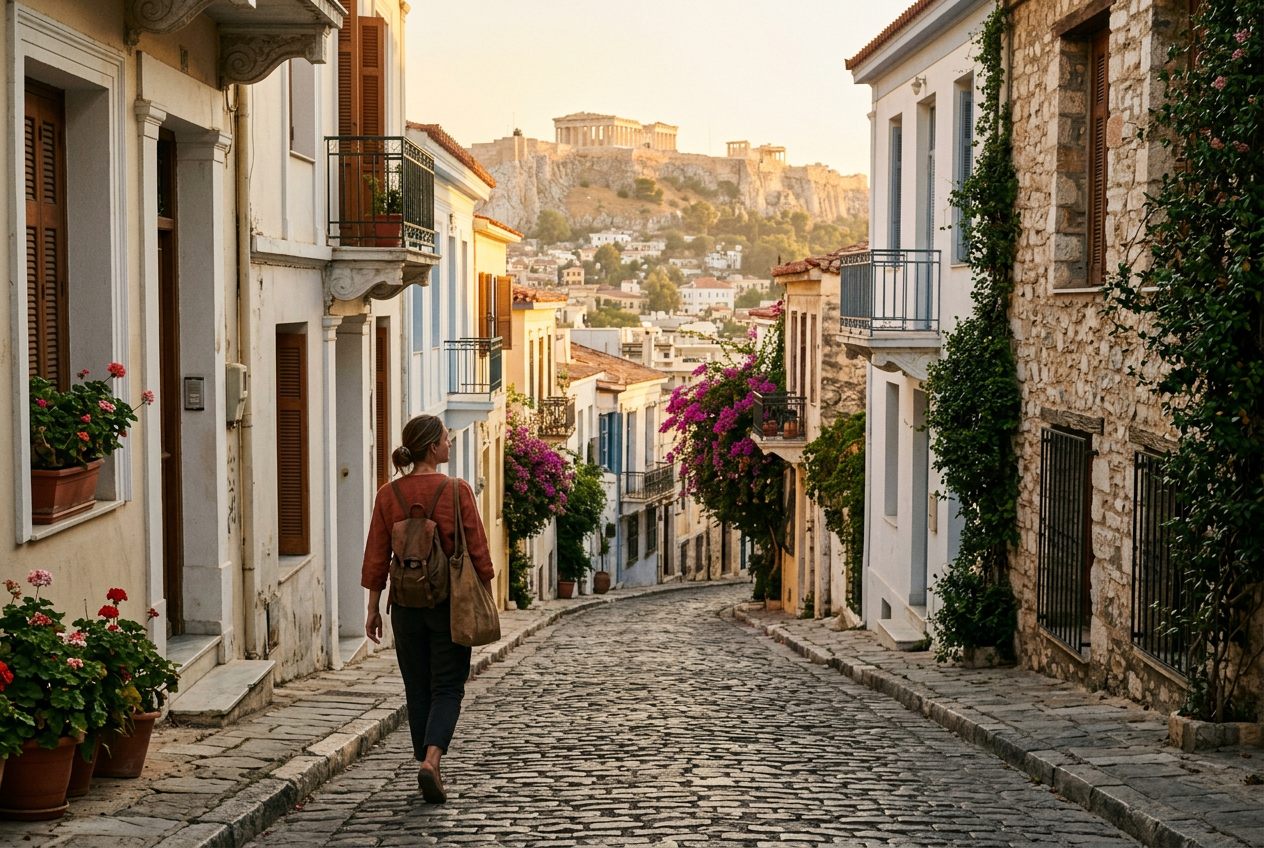
Athens has always been a city that takes ideas seriously.
The philosophical tradition Athens gave the world isn’t just historical furniture. It’s still in the DNA of the place: in the way arguments happen on street corners, in the political murals that get painted over and repainted, in the fact that the city’s most contested public spaces are the ones where ideas have always been loudest.
This is a city where the ancient conversation and the contemporary one are happening in the same streets. Sometimes literally.
The Ancient Conversation
The Ancient Agora was not primarily a marketplace. It was the arena of Athenian public life — the place where citizens gathered to debate, vote, litigate and philosophise. Democracy was practised here. So was ostracism: the process by which citizens could vote to exile a figure considered dangerous to the state, by scratching a name onto a pottery shard.
Socrates taught here. Not in a school or an academy, but in the open Agora, in conversation — the only method he had, and the one he refused to abandon even when it killed him. Plato’s Academy lay just outside the ancient walls, but the dialogues that defined Western philosophy were rooted in conversations that took place in spaces you can still walk.
The Stoa Poikile — the Painted Stoa, now partially excavated along the northern edge of the Agora — is where Zeno of Citium taught the philosophy that took the building’s name: Stoicism. The relationship between these ideas and this ground is not metaphorical. This is where it happened. Standing in the Agora with that knowledge, looking up at the Temple of Hephaestus, is not a religious experience. But it isn’t nothing, either.

The Contemporary Art Scene
EMST
The National Museum of Contemporary Art, housed in the former Fix Brewery in Neos Kosmos, is finally the institution Athens’ contemporary scene deserved. The collection covers Greek and international work from the 1960s to the present, with particular strength in Arte Povera and in Greek artists of the post-junta period whose work was shaped directly by political circumstance. The building is well designed, the programming ambitious, and entry genuinely affordable.
Galleries in Metaxourgeio & Psyrri
The gallery scene here is less institutionalised and more interesting for it. Metaxourgeio in particular has become a genuine hub over the last decade — galleries showing emerging Greek artists alongside international figures, in storefronts and repurposed industrial spaces that haven’t been aestheticised into placelessness. Walking the neighbourhood on a Thursday evening, when most galleries hold their openings, is a good way to take its temperature.
Exarcheia’s Street Art
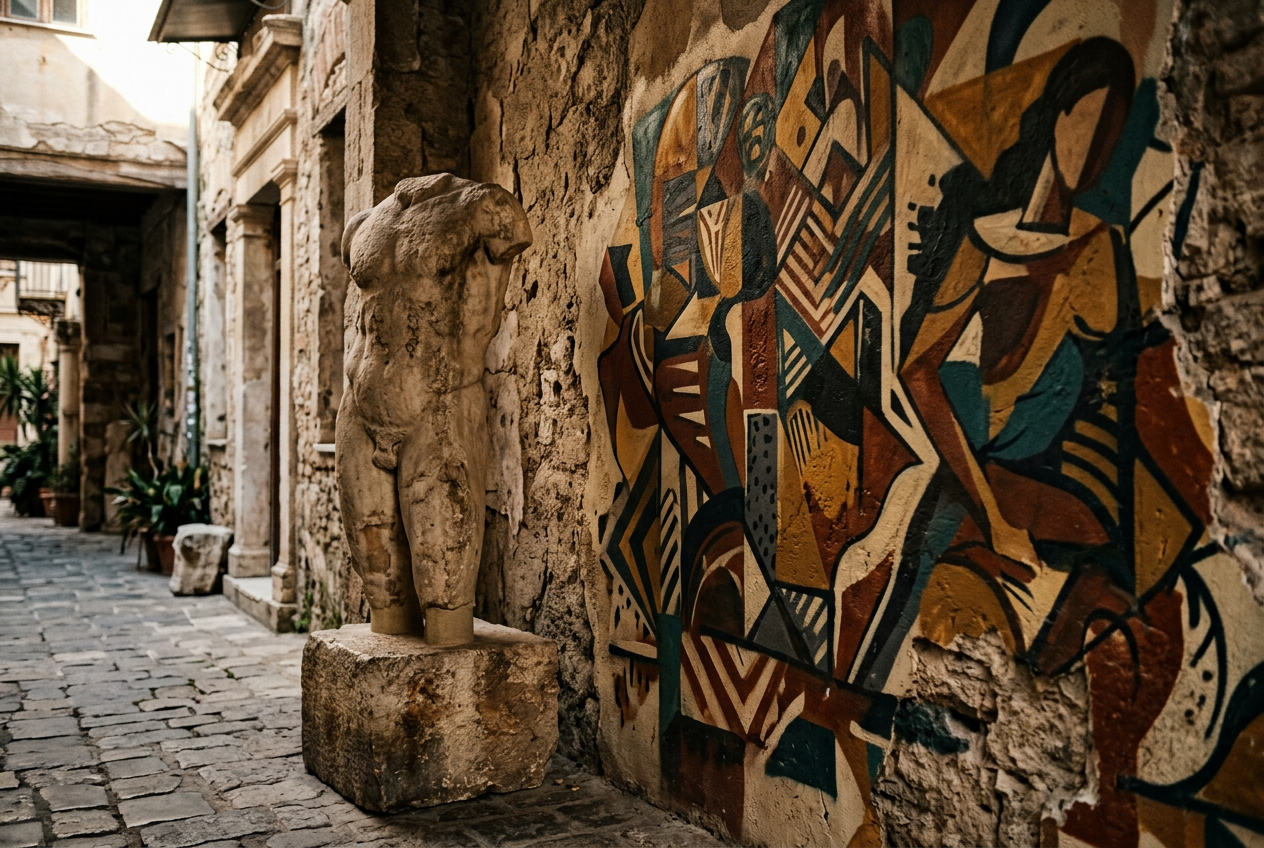
This is political in a way that separates it from the decorative muralism of most European cities. Exarcheia has housed left-wing and anarchist politics for half a century, and the walls reflect it: layered, argued over, sometimes painted out by the municipality and quickly repainted. It’s contentious and alive, and worth looking at seriously rather than simply photographing for content.

Architecture Worth Looking Up For
Athens has a complicated architectural identity. The ancient layer is obvious. Less discussed is the neoclassical layer imposed on the city after independence in the 19th century — a deliberate effort to reconnect the new Greek state with its classical heritage through architecture.
The Trilogy
The National Library, the University of Athens and the Academy of Athens run along Panepistimiou Street and represent the most concentrated expression of that project. All three were designed by the Danish architect Theophil Hansen, built between 1839 and 1902, and funded largely by Greek diaspora philanthropy. They are imposing in the way 19th-century institutional architecture always is, and more beautiful than that description suggests. The Academy’s allegorical sculptures — Athena and Apollo on their columns — are genuinely impressive at street level.
Brutalism
The contrast with brutalist Athens is everywhere once you start looking. The apartment blocks built during the rapid urbanisation of the 1950s–70s are utilitarian, often elegant in their way, and tell a completely different story about the city than the neoclassical Trilogy does. Athens is both of these things at once, and the tension between them is part of what makes it architecturally interesting.
The Stavros Niarchos Foundation Cultural Centre
The SNFCC, designed by Renzo Piano and completed in 2016, sits 5km south of the centre in Kallithea and is the city’s most significant recent architectural statement. It houses the National Library and the Greek National Opera in a building of considerable elegance, surrounded by a landscaped park that has become a genuine public space for Athenians. The rooftop canal garden, with its view back toward the Acropolis, is worth the trip.
Theatre, Music & Performance
Odeon of Herodes Atticus
A Roman theatre built in 161 AD by the wealthy Athenian Herodes Atticus in memory of his wife. It seats 5,000, has been in continuous seasonal use since the 1950s, and remains one of the most atmospheric performance venues on earth. The stone seating is hard, so the cushions at the entrance are not optional. The acoustics are better than any modern theatre has a right to be jealous of.

The Theatre of Epidaurus
The Athens Epidaurus Festival, running June to October, uses the Odeon as its primary Athens venue and the ancient theatre at Epidaurus — 150km south — for its major productions. The programme spans classical theatre, opera, dance and contemporary performance. Tickets for major productions sell fast; check the programme and book before arrival.
Megaron Athens Concert Hall
The city’s year-round classical venue: a large, well-programmed hall on Vasilissis Sofias Avenue running opera, orchestral concerts and chamber music across two auditoriums through the winter season. If the Odeon is the romantic choice, the Megaron is the serious one.
Athens has never been a city where ideas were kept at academic distance. The philosophy was argued in public. The art was placed in civic spaces. The theatre was a civic event, not an entertainment. That instinct is still there — in the street murals, in the arguments in the kafeneion, in the fact that Athenians will still, without much prompting, debate the nature of democracy in the city that invented it.