The city reveals itself slowly. Here’s how to walk it properly.
There’s a particular kind of travel exhaustion that comes from doing Athens wrong: burning through the Acropolis by 10am, ticking off the Agora, circling back to the hotel by noon, and wondering why you don’t feel anything. Athens rewards a different approach. Slower. More deliberate. The kind where you leave without a fixed endpoint and come back three hours later having found something you can’t quite name.
This is a city built on hills, layered with centuries, and designed — despite all appearances — to be walked.
Start Where the City Started
The base of the Acropolis hill is the logical beginning of any serious walk through Athens. Not the top — the base. Stand in Monastiraki Square in the morning, face the hill, and register what you’re actually looking at: a fortified rock continuously occupied for over 5,000 years, topped by a set of buildings that have defined Western architecture ever since.
The Ancient Agora sits just northwest of the Acropolis and is where the walk should properly begin. This was the civic heart of classical Athens — marketplace, courthouse, the place where Socrates argued and Athenians voted. Most visitors pass through quickly on the way to somewhere else. That’s a mistake. Spend an hour here before the crowds arrive and you’ll read the rest of the city differently.
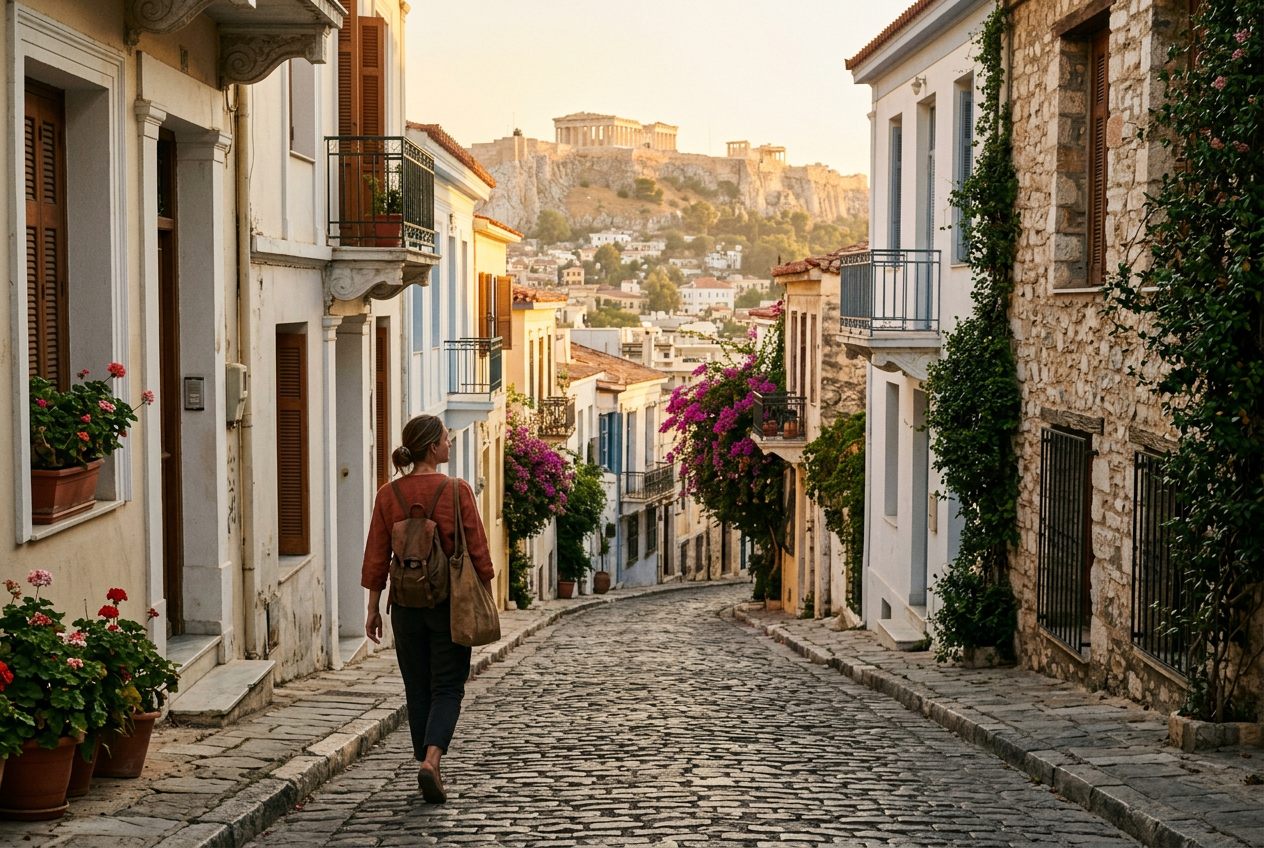
As you move through Monastiraki into Plaka, pay attention to the layers. Byzantine churches wedged between neoclassical apartment buildings. Roman columns jutting out of Ottoman-era streets. Athens doesn’t curate its history; it just accumulates it, and walking through it feels less like visiting a museum than reading a palimpsest.

The Neighbourhoods Worth Your Time
Plaka
The oldest continuously inhabited neighbourhood in Athens and — full disclosure — the most tourist-facing. That doesn’t make it worthless; it makes it worth navigating carefully. The main drag along Adrianou Street is fine for orientation, less useful for anything else. Push deeper into the residential streets toward Anafiotika and the atmosphere shifts entirely: quieter, older, more honest.
Psyrri
Just west of Monastiraki and running at a different frequency. It’s where the galleries are, where the good street art is, where you’ll find a bar open at noon with locals eating lunch and no one performing Athens for your benefit. It’s scruffy in places and better for it.
Koukaki
The neighbourhood immediately south of the Acropolis, beneath the hill’s shadow in the most literal sense. Largely residential and genuinely local, with a good concentration of independent cafés and restaurants. This is where many of Athens’ working professionals actually live, and walking it feels like being granted brief, unearned access to a private city.

The Walks Nobody Writes About
Filopappou Hill
Southwest of the Acropolis, Filopappou offers what is, honestly, a better angle on the Parthenon than many official viewpoints. The path is rocky but passes through a shaded pine forest that provides relief from the sun before the summit. At the top, the monument to Filopappos — a Syrian prince and Roman consul — stands against the sky, and on a clear day you can see from the Acropolis across to Piraeus and the coast. Very few people make it up. It’s worth every step.

The Panathenaic Way
The processional road running through the Ancient Agora, along which ancient Athenians walked to present offerings to Athena during the annual festival — with greater grandeur every four years. You can still walk the route; parts of the path retain the original marble slabs laid down in the Roman era, letting you follow the exact footsteps of ancient festival-goers. The Temple of Hephaestus stands at the end, overlooking it all — one of the best-preserved Greek temples anywhere in the world, and deserving of more attention than it gets.
Strefi Hill
Strefi Hill in Exarcheia is the rawer option: graffiti on the way up, a shaded open-air café tucked below the rocks, and a view across the rooftops of the most politically charged neighbourhood in Athens. It’s not polished. It’s not supposed to be. Go on a weekend morning, while the city is still quiet and the light is good.
Some Real Talk
Athens in summer is hot. Not inconveniently warm — genuinely, functionally hot. Between roughly 11am and 4pm in July and August, walking the exposed archaeological sites is an exercise in endurance rather than pleasure. The solution is simple: go early, find shade by midday, walk again in the late afternoon when the light is better anyway.
Footwear matters more here than in almost any other city. The streets in Plaka and around the sites are largely marble-paved or cobbled, worn smooth over centuries, and become genuinely slippery when wet. Comfortable, rubber-soled shoes are not a suggestion.
Athens has a number of public water fountains, particularly around the Agora and the base of the Acropolis. They work. Use them. Shade stops worth knowing: the courtyard of the Agora museum, the garden behind the Benaki, and any of the small churchyards in Plaka that leave their gates open during the day.
Athens is one of those rare cities you don’t fully understand from a viewpoint or a photograph. You understand it by walking — by crossing from one neighbourhood to the next and feeling the shift, by finding a Byzantine chapel wedged between a car park and a souvlaki stand and realising that this is just how the city is.