Athens eats well. You just need to know where to sit.
Greek food has a reputation problem. Decades of package tourism did real damage — moussaka under heat lamps, watery tzatziki in plastic pots, lamb chops priced for people who aren’t checking. The result is that many visitors eat badly and assume that’s just how it is. It isn’t. Athens has an extraordinary food culture. It’s just that a good portion of it isn’t pointed at you.
This is a guide to finding the part that is — and getting the most out of it.
How Athens Actually Eats
Greeks eat late. Not European late — genuinely late. Lunch rarely happens before 2pm. Dinner in most neighbourhood restaurants doesn’t fully get going until 9pm, and it’s common to see families with children sitting down at 10pm without anyone finding it unusual. Arrive at a taverna at 7pm and you’ll be eating alone, with the kitchen only half-awake.
Knowing what you’re walking into helps, too. A taverna is the most common form: casual, usually family-run, focused on grilled meats, shared plates and a short, honest wine list. A mezedopoleio is built around meze — small sharing plates, more variety, more leisurely. An estiatorio is a step more formal, with printed menus and a broader range of cooked dishes. All three have their place, and knowing which one you’re in changes what you should order.

The menus along Adrianou Street in Plaka and around the tourist-facing edge of Monastiraki are almost universally designed to extract money from people who won’t be back: higher prices, lower quality, food that bears a polished-down relationship to what Athens actually eats. Walk one street further in any direction and the equation changes.
The Neighbourhoods to Eat In
Monastiraki & Psyrri
Where you want to be for casual, late-night eating that doesn’t require planning. The souvlaki spots around Monastiraki Square are some of the best in the city. Thanasis and Bairaktaris are famous and decades old, but often seen as tourist traps by locals; for a more authentic souvlaki, head to Hoocut, or the legendary Kostas near Syntagma. Psyrri sharpens things up slightly — better wine lists, more interesting meze, kitchens that take the food seriously without making it precious.
Koukaki & Neos Kosmos
Where Athenians go when they’re not performing. These residential neighbourhoods south and southeast of the Acropolis have restaurants without translated menus in the window — that’s the tell. If you see a menu in four languages without being asked, you’re in the wrong place. Koukaki in particular has developed a strong cluster of independent restaurants in recent years without losing the neighbourhood feel that makes it worth visiting.
Exarcheia
Exarcheia feeds people cheaply and well. The city’s leftist-bohemian neighbourhood is politically intense and gastronomically honest: cheap wine, very good horta, generous portions, and a dining room likely to include students, artists and people who’ve been eating at the same table since the 1980s. Nobody is there to be seen. It’s the rebellious soul of Athens, and the food is the point.
What to Order
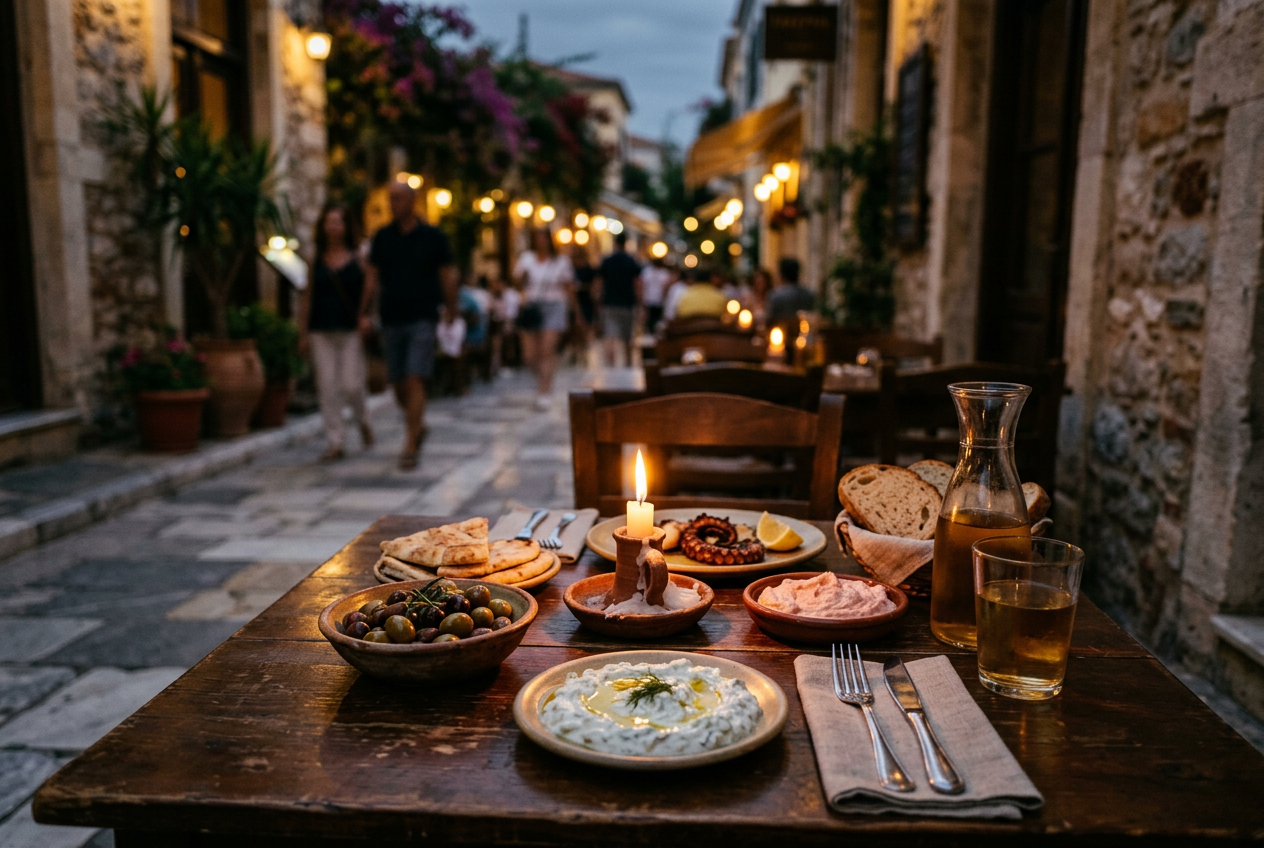
Some dishes are worth understanding before you sit down. Taramasalata is fish-roe dip; the high-quality, undyed version is actually creamy white, as even a pale pink hue usually signals food colouring. Horta — boiled wild greens dressed with olive oil and lemon — is one of the most underrated things on any Greek menu. Grilled octopus should be charred at the edges and tender through; if it’s rubbery, it wasn’t prepared properly. Lamb chops (paidakia) are a benchmark: a good taverna’s version tells you everything you need to know about the kitchen. Tzatziki is simple enough that it’s hard to fake, yet frequently faked anyway — the good version is thick, garlicky and made with strained yoghurt.

Greek wine is having a moment that’s been a long time coming. Assyrtiko from Santorini is the white to know: mineral, dry, high-acid, pairs with almost anything from the sea. Xinomavro from northern Greece is the serious red, often compared to Nebbiolo in structure. Retsina — the resin-flavoured wine many visitors approach warily — is worth trying once, ideally cold, with fried food. It makes more sense in context than in description.
Coffee, Pastry & the In-Between Hours
Greece runs on coffee — specifically, on cold coffee, a preference that confuses many visitors and converts most of them within 48 hours. The freddo espresso and freddo cappuccino have become the modern Athenian fuel, largely displacing the original frappe: the frothy, shaken instant coffee that started the cold-coffee craze here in the 1950s.

Loukoumades — fried dough balls soaked in honey — are Athens’ street food in the truest sense. Lukumades on Mitropoleos Street near the cathedral is the reference point, but the best are often at small, barely-signed spots that have been doing the same thing for thirty years. Bougatsa, a pastry of Thessalonian origin that Athens has fully adopted, is flaky filo filled with semolina custard, dusted with cinnamon and icing sugar. Ariston on Voulis Street, where most people send you, is actually legendary for its pites — specifically its golden, buttery kourou cheese pie.
The other thing to know about Athenian café culture is that no one will rush you. You order, you receive, you sit for as long as you like. The bill does not arrive uninvited. This is not inefficiency — it’s a different understanding of what a café is for.
The best meal you eat in Athens will probably not be the one you planned. It’ll be a table you spotted through an open door, a menu you couldn’t fully read, a carafe of house wine that turned out to be excellent. Athens rewards the willingness to sit down without knowing exactly what you’re getting into.